18 May 2014

Padova: Link in a Golden Chain

However lovely Florence and Tuscany were, we could not stay there forever. We had hotel reservations back up north, and so we said goodbye to the warmth of Tuscany and boarded a train to take us to Veneto. Breaking our journey in Bologna allowed us to spend a considerably smaller amount of money on our tickets. Several people we crossed paths with planned on stopping in Bologna for the next leg of their own trips from Florence, and both of us were a little bewildered by their decision to do so. What attractions does Bologna have? Had we made a mistake in leaving it off our own itinerary?
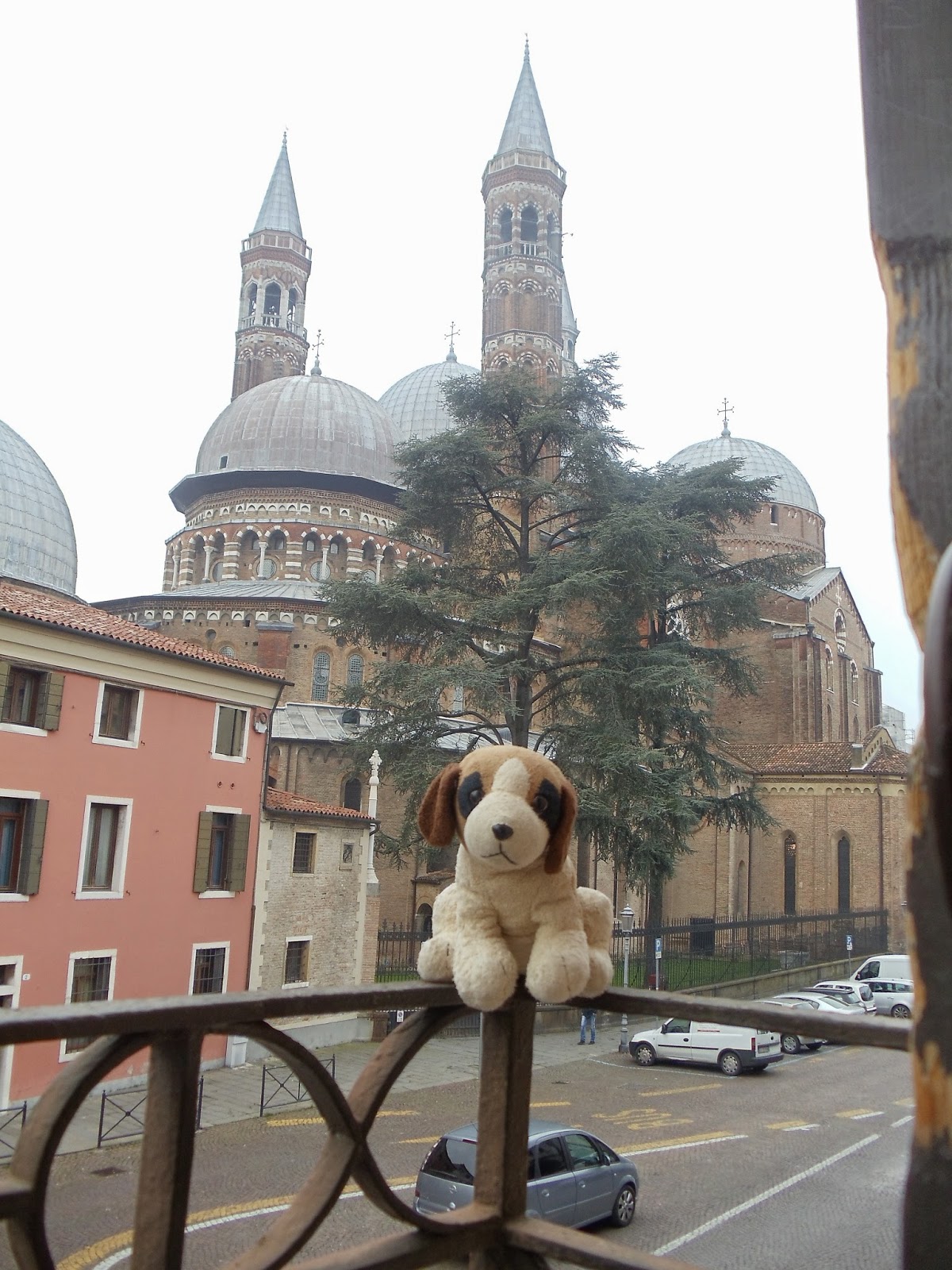
The view from our hotel balcony.

Regardless, it was too late to change it now, and our time in Bologna was spent eating the last of our food from the supermarket in Sienna: apples and peanut butter, a perfect snack. Back on the train, I fell asleep. After embarking in Padua, we successfully navigated the public transportation system and found our way to our hotel, which was remarkably literally a stone's throw away from St Anthony's Cathedral. We spent our first hour in Padua marveling at the differences between a hotel and a hostel. Our accommodation in Florence had been perfectly adequate, but this hotel provided a free map, we had our own room, with our own bathroom, and a balcony which looked out over the Cathedral. Sometimes it pays to pay.

Because of it's proximity, our first stop in exploring the city of Padua was the Cathedral, a famous pilgrimage destination for people petitioning Anthony, the patron saint of an endless list of professions, hobbies, and events. Stepping into the cathedral, my breath caught in my throat. Every inch of the interior was carved or painted or adorned in someway. It was overwhelming. Surrounding the main nave of the church were a number of smaller chapels, some with paintings and altars, some with statues, one with relics, and one, the largest of them all, the tomb of Anthony himself, with a file of people walking by. As we passed, a group of preschool-age children were being ushered out by their ragged looking teachers, a job I did not envy them.

We stayed inside for long minutes, trying to see everything, to understand the amount of work that went into such a building, to appreciate the devotion that motivated the innumerable carpenters, sculptors, painters, and other artists to build such a resting place for one holy man. Finally, we vowed to return, and made our way back out onto the square and towards Piazza Bar, the largest Roman piazza in Italy.


It too was lovely, in a very different way. The borders of the square were buildings with the ubiquitous arches of Padua, all graceful, all providing a covered walkway around nearly the entirety of the square. The center of the square was an artificial island, surrounded by a moat and reached by one of several bridges. On either side of the moat were statues of presumably famous Italians, although the only name we recognized was Galileo.
     Unlike any of the other cities we had visited or were planning to visit, Padua doesn't really have any blockbuster sites. The charm of Padova is it's atmosphere, the city itself. We spent the rest of the day wandering around the city, not really having a destination in mind, but wanting to get a feel for this city. If Sienna was like a museum, walking through Padova was like walking onto a very large movie or theater set. The columns and arches were impossibly real, improbably recognizable from Kiss Me Kate.

The only other specific sites we saw were more churches: a beautiful little chapel in the middle of construction, and another cathedral which although it didn't have the splendor of St. Anthony's, I think I ended up liking better for it's simplicity. We saw some market squares, and stopped for hot chocolate and coffee in an adorable cafe to get out of the rain where we were mistaken for Dutch girls.

For whatever reason, whether it was the rain which caught us off guard, without our umbrellas, the fact that our trip was now halfway over, or the simple action of having moved that day, I was in an unreasonably bad mood. I stuck it out as long as I could, and tried to enjoy the city, even in the rain, but when the simple plans we were making about where we were going to eat continued to be foiled by odd opening hours, I was over it, and fairly begged Abbie to go back to the hotel.

We solved our food problem by asking at the hotel for the nearest supermarket. We trudged down the street, and peered into storefronts, wondering if this was it, and nearly gave up. But then we found it, and discovered that it was called Meta! This simple fact made the finding of food even more exciting. We purchased a random selection of food, took a picture with my namesake, and returned to the hotel, ready to spend the rest of the night in our pajamas watching TV on Abbie's phone.


After that first day, our time in Padua was limited to the walk back from the train station after our trip to Verona, and the hour we spent back in Piazza Bar our last morning there, reprising our roles as statue imitators, a most amusing pastime. We certainly enjoyed ourselves, and probably entertained the people around us as well.

Though, as I said earlier, Padua doesn't have any sites on par with Florence, or Venice, or even Verona, it is quite a nice town. The arcades and arches, the pedestrian cobblestone streets, the restaurants and shops geared towards university student budgets, one of the laziest rivers I have ever seen in my entire life, the beautiful buildings tucked surprisingly down tiny alleyways, the arches which open into piazzas, they all add up to one of the most natural cities I've seen. Because most of the tourists coming into town are there for St. Anthony, it doesn't have to put on a show for the gawkers who wander the streets of other Italian cities. The students permeating the city give it a youthful atmosphere which completely belies it's considerable history.


By the time we left, with three nights left before I'd be back in Bratislava, I found I had reconciled myself with the city and wanted to stay and make amends for my earlier unreasonableness. Instead, we boarded a train for the 20 minute ride to Venice, our final destination.

12 May 2014

Decisions, Decisions

     As those of you who know me well are quite aware of, I am a champion of indecision. I dither, and dather, look at every possible angle, stress out, and generally make myself miserable. I've come to realize that most often, there isn't a right or wrong answer to my problem. Usually, I'm trying to decide whether to follow the lead of my head or my heart, which almost always want different things.
     Recently, my dilemma has been about staying in Bratislava; whether to commit to the school, the kids, Petrzalka, and Slovak for another whole year. My original commitment was to come for the semester, while leaving the possibility for next year open on both sides. Within days of my official visa coming through, I was signing my contract, and the principal told me they would love for me to return. There was absolutely no hesitation on their part, which was encouraging, but not a sentiment I could match. It felt good knowing that I had done a strong enough job for them that they would unreservedly ask me back, but I asked for time to think about it, and was given a month.
     In typical Meta fashion, I went back and forth. Just like when I was trying to decide between Istanbul and home, I had moments where each option seemed inevitable, and I couldn't imagine doing anything else. But then something would happen, or I would have a conversation with someone, or I would do nothing but wake up, and my mind would have changed. My thoughts percolated in my brain, filtering into my consciousness without much drama. I was proud of myself that I was handling this decision-making process so well.
     And then, the day before our new flatmate was due to arrive, after a conversation with my supervisor, I nearly had a panic attack on the bus ride home. The decision that I thought I had made was turned on it's head, and I was no longer sure. She hadn't even said anything to try and sway me either way. Like the incident with the Czech postal system, it just created a storm inside my brain which made me question everything both my head and my heart had been telling me.
     My head, the logical part of me, had been saying that staying in Bratislava made so much more sense than leaving. My visa was taken care of, I had a job, a place to live, friends. I wouldn't need to readjust to a new foreign language, and would maybe even be able to pick up a decent amount of Slovak. I'd be in Europe, convenient to possible grad schools, as well as some of the most beautiful places on the planet. Teaching could only get easier; I would know most of the kids, I'd be teaching the classes right from the very beginning, and I'd have an entire semester of experience under my belt. Perhaps most importantly after all the teacher turn over this past year, they would have a consistent faculty, good for both the kids and the school itself. Staying here would make sense, in many important ways.
     My heart, on the other hand, reminded me that there was so much more in the world than Europe, that I had looked at jobs in Latin America and Asia before hearing about C.S. Lewis. It told me that the challenges of Bilgym would not go away just because I was an 'old' teacher. It tugged me towards another new adventure, a fresh start, and some time at home.
     The conflict had come to a head that day on the bus, and I knew I needed to make a decision as soon as I could, because otherwise, I was going to lose my mind. So that whole first weekend with Sierra here, as I was showing her around the school, around Bratislava, there was always a voice in the back of my head asking if I could stay here. Her newness, her optimism and excitement, threw my indecision into greater relief.
     Finally, finally, on Sunday after almost a week, I made my decision. Or rather, I made my peace with the decision that I had been fighting for weeks.
     I am, once again, choosing to come home, at least for a while. I decided that the possibilities the world was offering me were worth more than all the security Bratislava could. I decided that no matter how much I wanted to give the kids a sense of continuity, I wouldn't be as valuable a teacher if I didn't want to be there myself. I decided that I could use the experience I gained and lessons I learned here (and for which no words can sufficiently express my gratitude) more effectively somewhere else.
     So now I am once again job hunting. I've sent out some resumes, received some positive responses, and scheduled a couple interviews, all in South and Central America. I'm confident that I will end up where I'm meant to be, as that clearly is no longer Bratislava.
     Ideally, this means I will get home early in July, and spend my first week in the States not in Minnesota, but in Tennessee with KY Reunion. Then, after several weeks of relaxing, seeing people I love, and enjoying the city that will always be home, I would head back out. Not east this time, not across an ocean to Europe, but south, possibly across the equator, to explore a new part of the world. I don't know exactly what's in store for me, a state which I am rather reluctantly getting used to, but I'm excited to find out.

03 May 2014

Back to Prague

Once I was going to be spending this spring in Bratislava, I knew I was going to go back to Prague at some point. What I didn't know was how I was going to feel about it. My time in Prague was hard, and it ended "not with a bang, but a whimper". An abrupt whimper, but a whimper nonetheless. I wasn't sure how I was going to reconcile my admittedly mixed memories of life in Prague with the reality of actually being there again. So when I boarded the bus in Bratislava on Friday afternoon, I was excited, but also a little apprehensive of the possible range of emotions the next several days were going to throw at me.

But when I emerged from the Metro out onto Namesti Miru, it was like I had never left. Everything was exactly as I remembered it. The only thing different was the layout of the street crossing, a project they had been in the middle of 5 months ago. As I walked up the street towards both my current hostel and my former flat, I was living in deja vu. It felt so right, but completely wrong at the same time.


After checking in and finding a bed, I reorganized my bags and fairly ran out the door. I wanted, maybe needed, to go back to Havlickovy Sady, back to my park, in order to reset myself in this city. Once there, I reveled in it's separate-ness. When you're there, it's like the rest of the city doesn't exist. This is something that Bratislava doesn't have, in really any form. There's nowhere you can go, and just forget where you are. The parks are lovely, but are lined with buildings and fences. The canal through Petrzalka is nice, and the lake is a pleasant surprise, but there's no escaping the fact that you are in the middle of Petrzalka. There's no way to break out of the pattern of the city. It was rejuvenating, and exactly what I needed.


Following my sojourn into the forest wonderland, I went over to a friend's flat for dinner. My Prague friends were always the best part of living here, and seeing them again was wonderful. We caught each other up on our lives, ate delicious soup, and I laughed more than I have in a long time.
   
On Saturday I went for a wander around the city, beginning with breakfast in Namesti Miru, watching the spires of the church gradually come into focus as the morning fog burned off. One of the many advantages of visiting a city you're already quite familiar with is that the level of guesswork as to which route to take in order to see everything you want to see is greatly reduced. Wanting to start at the castle, and work my way back to Vinohrady, I took the Metro to Malostranska, and climbed the stairs up to the level of the castle, shedding my cardigan, jacket, and scarf along the way. The sun was bright and hot, but had not yet reached the lower, more crowded parts of the city, so the distant landmarks were shrouded in mist. After wandering around the castle grounds and discovering some spectacular gardens, I made my way back down the hill and back to the Charles Bridge, with a detour to the Lennon Wall. Crossing the river, I made my way to Old Town Square, inadvertently arriving on the penultimate day of the Easter markets. I walked through Namesti Republiky, past the Powder Gate, and up Wenceslas Square back to Vinohrady, where I spent a blissful hour laying out in the sun in yet another city-defying park. Throughout the day, as I revisited these places that I once was able to call part of my home, my heart ached, and I found myself thinking: "I wish I could have been happy here."


That, I think, sums up my feelings about Prague. It is a beautiful city, with myriads of opportunities, a rich history, deep cultural significance, and a future full of possibilities. I would have loved to have been able to stay. To watch the city change from fall to winter, and from winter to spring. I would have loved getting to know her more, to recognize and appreciate her quirks, but it wasn't in the cards for me. For many reasons, Prague was not going to make me happy last fall, and forcing the point would not have been wise. It's possible that we'll get a second chance at some point, but I don't see that happening in the near future.


This visit to Prague was bittersweet. I love this city. It has vibrance, and color, life, history, pride, and some pretty great people. Being back on the familiar streets was wonderful, but it also made me sad because it no longer belongs to me. Or rather, I no longer belong to it. I'm the one with the backpack going to a hostel, not unlocking the door to a flat. I'm the one who has to buy Metro tickets because I don't have a pass. Obviously, I've done my fair share of tourist-ing, but I've never been a tourist somewhere I've lived. I suspect I'll have a similar reaction when I go back to Olaf. With so many memories tied up in these places, it's hard to be just another visitor.

The only language that seems appropriate to describe my feelings about my visit are relationship-centric, which I guess is appropriate. You can't live somewhere and not have a relationship with it, even if it's not the same as having a relationship with an actual person.

Prague is my one that got away. We tried, it didn't work, and we parted on relatively good terms. We both moved on. But there will always be a question mark surrounding the possibility of what could have been. What if we had tried harder? Could things have been different?

Whatever ends up happening, I am so blessed to have had the time that I did there. I met some wonderful people, grew a tremendous amount, and learned things about myself I could not have anywhere else. I once called Prague home. And even if I never do again, that will be enough.

12 April 2014

Days Off

I passed up on an opportunity to go to Vienna today with my flatmate. It's absolutely gorgeous out, and I spent the day in leggings, a sweatshirt, and fuzzy socks eating leftovers and watching How I Met Your Mother. Even my attempts at productivity-taking a stab at grading some essays, starting to create lesson plans for next week-inevitably returned to my staring at the screen, my eyes starting to ache a little because I have almost literally done nothing else today.
   
Guess what? I'm homesick.

This is what I want right now.
I miss Minneapolis. I miss the river, my backyard, Lake Street. I miss the dog. I miss my bookshelves, and my teddy bear, and my handmade quilt. I miss being able to read signs, and knowing I won't have to wander around a grocery store looking for an obscure item, because I could always ask someone and they would understand me. I miss church, and playing with the babies every Sunday morning. I miss the newspaper and the crosswords that came with it. I miss the Riverview. I miss my bike. I even miss the absurd weather. But most of all, I miss the people. I miss my friends. I miss my family. I miss watching football with my dad, and cooking with my mom. I miss curling up with my sisters on the couch. I miss feeling like I belong somewhere.

As much as I've grown to appreciate Bratislava, it doesn't feel like home. I've hit the point in my time overseas that the cultural quirks have ceased to be simply baffling or endearing, but annoying. When I was at this point of my time in Prague, I had decided to go home after the death of my grandfather, and was counting down the days until I could get on the plane. But that's not an option now. And even if it was, it's not one I would want to take advantage of.

Being away from home is hard. Starting a new job is hard. Living in a new country, with new people and a new language is hard. Doing all those things at once? It's really, really freaking hard.

And this.
But life should be hard. If you never challenge yourself, you're never going to grow. I've been following the blogs of some of my fellow expats, and watching their journey from being exactly where I am right now, to loving their lives and not wanting to leave is incredibly inspiring. If I gave up and went home I would never forgive myself. Because yes, being homesick sucks. But regret, I think, would suck more. Those what ifs, those giant question marks, they'd never go away.

I don't regret going home last October. It's what I needed, it's what my family needed. I am absolutely certain I made the right decision there. I'm equally sure that right now I'm where I'm supposed to be, and not only because I'm finally living and working here legally. No matter what else happens, whether I decide to stay next year or not, I definitely won't be leaving Slovakia the same person I was when I arrived.

So, no. I'm not going to beat myself up about not going to Vienna today, or even about not leaving the house. I'm in the middle of an adventure, but even adventurers need days off.

30 March 2014

Playing Catch Up

     I realized recently that I've been neglecting writing about my real life here in Bratislava because I'm so behind on my Italy posts, and that's not really fair. However beautiful Italy was, Bratislava is so much more my life that not writing about it because it's not as exciting is stupid. I will continue to post about my Italian adventures as time allows, but I'm not going to put everything else on hold because of it. So here goes. An update on my life in Slovakia.

City center from the walls of the castle.
School: It's hard to believe that I've been teaching for almost two months. The time has absolutely flown by. I've learned so much in these past two months it would be impossible to describe all of it, and it would probably bore you all to death anyway. So I'll summarize. The first several weeks, even up until spring break, I was primarily trying not to drown beneath everything I was doing: planning classes, grading assignments, figuring out the various systems for grades, attendance, and substituting. It was rough. There were times I'd go into class not really having a clue what I was going to teach these kids for the next 45 minutes, and need to think on my feet to fill up the time, sometimes more successfully than others. Also, I just didn't (and still don't) feel old enough to have authority over these kids. Yes, I'm 24, and I have a college degree, I know that. But I don't feel that old, and it took a while before I was able to convince myself that I could, in fact, tell these kids what to do, and grade their essays, and ask them to behave in class. There were absolutely moments where I wanted to break into tears, and there were moments when I did. I was overwhelmed, unsure, and self-conscious of the fact that I didn't have the faintest clue what I was doing. As a die-hard perfectionist, and my own worst critic, I was tearing myself apart. I had good days, but I was concentrating on the bad ones. There was no middle ground for me; I was either a really good teacher, or someone who couldn't accomplish anything in the classroom. It sucked.
     But I don't feel that way anymore. Or rather, I feel that way significantly less often than I did before. Don't get me wrong, it's still really difficult, and I still feel like I want to pull my hair out sometimes, but I'm learning how to cope. I've started planning lessons out more than a day at a time. I'm able to cut myself some slack and not grade papers the day they're handed in to me. I've gotten more comfortable with my students and am able to relax more in front of the classes. I've realized I don't have to be a "teacher". I have to be me, as a teacher, and that's probably what has helped the most.
UFO Bridge and Petrzalka from the Castle.
    Though much about teaching has gotten easier in the last couple months, there are things that have gotten harder. I started teaching, as many people do, with thoughts of inspiring young minds, of eager students with good questions, wanting to be taught. While those things may exist in some places, they don't here. I know my classes better than that, and am able to recognize that, with a few exceptions, no matter what I do, no matter how well I plan out my lessons or how thoughtfully I grade their papers, they're still not going to appreciate it. It's discouraging, to say the least. My naivete, while mostly a burden, was also a little bit of a blessing.  I'm still on the fence about whether I want to keep teaching or not but at least now I know that when I do have to answer that question sometime in the relatively near future, I'll have an answer based neither on fear nor optimism. I'll have an answer based on real life.

Bratislava: You may recall that my first impression of Bratislava was not the greatest. I thought the city was, for the most part, ugly, dirty, inconvenient, and frustrating. That opinion has definitely changed. Spring came early to Slovakia this year, and it has been very kind to us. While my family in Minnesota was buried under drifts of snow, the trees were starting to turn green, the sky was consistently blue, and I was able to go outside with bare limbs. The last month has been absolutely gorgeous, even during the cold snap we had the temperature barely got down to freezing even at night. The city has come alive. Walking around downtown and seeing all the cafes and restaurants with their tables out along the sidewalk instead of jumbled all together inside, being able to have an ice cream cone (for significantly less than a euro) and not worry about shivering, wandering through the city center at night in a light jacket comfortably, all these things have greatly increased my appreciation for Bratislava. It really is quite a nice little city.
Along the canal in Petrzalka.
     Even Petrzalka is growing on me. Last week I went for a walk along the canal and discovered a lake! A little lake, but a lake nonetheless. With the grass turning green and the trees starting to blossom, even the concrete blocks start to look less foreboding.
     At some point I'm going to have to force myself to sit down and write about Bratislava. The problem is that now that I've lived here, I'm recognizing things that a visitor wouldn't. I can't be as flighty as I can be with other cities. Bratislava is more than a place I've visited, it's become a place I've lived, and that makes it infinitely more difficult to document. It's more than the buildings, more than the atmosphere, even more than the contrasting elements of it's history. It's complicated, and what's more, I understand that it's complicated. Florence, for all of it's loveliness, has to have some complications, but I can go there and not see them, because they're well hidden from the eyes of casual tourists. Day-trippers don't want complicated, they want the Duomo and the Uffizi, so that's what they get. Even if Abbie and I did stray from the tourist track, we were still only in Florence for two and a half days, not nearly enough time to become more than acquaintances.
     But that's not real life. Bratislava is real life. It's a real city, with real problems, problems that I have experienced, problems that, even if I can never understand them, I can recognize. At the same time, it has more joy hidden in it than I've seen so far, more to offer that I have yet to take advantage of. There's so much more, of everything. That's why it's so hard for me to write about Bratislava, and maybe that's part of the reason I've been putting this off. I know too much about the city to write from a tourist's perspective and not enough to write from a resident's perspective.
     So I guess that's where I have to leave it. That's my life, in the smallest of nutshells. I'm going to try my darndest to write more frequently, about Italy, about the impromptu day trip we took to Budapest, about what I'm doing here as a Bratislavan, about what I'm thinking as I move forward into the future and about the decisions that are, once again, going to have to be made about my life and how I want to live it.

23 March 2014

Siena: Vague Historic Dust

     On our last day in Florence we decided to venture out into the Tuscan countryside and spend the day in Siena, a medieval hill-town about two hours away by train. We stopped by the Duomo again to take another stab at acquiring a trash can on which to place Charlie for a picture, and finally we were successful and turned towards the train station with unburdened consciences. The train ride was beautiful, and we disembarked at the Siena station eager to explore this town we knew almost nothing about. We were initially frustrated by the lack of information about how to get from the station into the centre of town because though the sun was shining bright and warm, it was still February and solidly in low tourist season. Eventually we did manage to purchase bus tickets without having to ask for help and made an educated guess as to which bus to take. We were right, as it turned out, and we followed the crowds from the broad modern streets into the narrow passageways of the medieval centre and were lost to the world.
     Our first, and only real goal for the day was to find the Piazza del Campo, so we followed the signs along the winding streets, gaping at how well-preserved, how alive this city seemed. Despite the narrow-ness of the streets, people, cars and bikes all carefully made their way up and down the hills, sometimes with calls too close for comfort. Having spirited some uneaten croissants away from the hostel that morning, we somehow needed to find some other food before doing much exploring. Stumbling upon a supermarket, we ventured inside and successfully purchased two blocks of cheese, and several apples which we crammed into our bags, unwilling to eat them until we had found somewhere other than a street corner to sit down. Giddy with excitement about having food and being in this remarkable town, we walked down the street arm in arm. Not long after that, I started to notice passageways heading off to the left, and down. They were small, so I ignored them, but then there was one I couldn't ignore. This one was wider, lined with tacky souvenirs, and the light at the bottom of the staircase shone brightly. Our arms came unlinked as we carefully made our way down the stairs, and my eyes got bigger as more of the square gradually came into view.
     And there it was, the famous Piazza del Campo. We stood on the very rim of a giant shell, our eyes blinking in the sudden sunlight. Anchoring the square was the Palazzo Pubblico at the bottom and dozens of buildings all around the rim as if without them the entire square would crumble into the volcano over which it's built. We found a place on the square amidst the other small groups gathered there and ate our lunch, astounded by what we had discovered almost entirely by accident.
     Although the town claims to have been founded by Senius, the nephew of Romulus, the founder of Rome, it did not thrive under Roman rule, being located far from any major roads. It wasn't until the Lombard occupation sometime around the 6th century that it gained importance as a trading post, with the necessity of rerouting trade routes to avoid the Byzantine raids along the old Roman roads. After the Lombards surrendered to Charlemagne in 774 it was passed between various rulers, until the unification of Italy during the 19th century. Since then, the city has thrived as a tourist destination, a centre for humanist studies, and as an agricultural producer.
     After finishing our lunch we headed back out into the city, ready for whatever we happened to find. We passed through several beautiful courtyards, lovely in their fading beauty, clearly cherished by the population. We soon found ourselves searching for the Cathedral, which we found, and which took our breath away with it's beauty, and sheer size. Though smaller than the Duomo in Florence, it seemed larger, being surrounded by such a warren of streets. It was unexpected, this massive building situated in such a small city on top of a hill. We discovered with regret that in order to go inside you need to purchase a ticket, so we resigned ourselves to admiring the exterior, a very respectable consolation prize.
     After leaving the cathedral square, we spent the rest of the day exploring the city. We found it is nearly impossible to get lost in Siena, as long as you stay within the confines of the old city walls. Though you may never know exactly where you will end up when turning a particular corner, you can be sure that eventually the labyrinth of streets will guide you back to the Campo. I suppose that's one of the benefits of living at the top of a hill with such clearly defined boundaries, whatever other drawbacks such a situation may possess.
     At one point during our ramblings we noticed a sign that pointed to the Porto San Marco, the Gate of Saint Mark. Without a real intention of doing so, we began wandering downhill and came upon an old gate, which was beautiful in itself, but even more spectacular for what lay beyond. As we passed under the pedestrian archway, my jaw dropped. Immediately in front of us was a small plateau with a playground, and the the ground dropped away to reveal the Tuscan hillside under the party sunny sky. I sped my pace up, anxious to get a closer look, and I was not disappointed. Both of us tried to capture the rolling hills and distant villas on our cameras, knowing the whole time that no picture could do it justice. We stood in silence, much as we had done on the Piazzelle Michelangelo, trying to sear the image into our memories. My admiration of Siena turned to vague disbelief at what the walls and tall buildings were shutting out and how casually it was reintroduced.
     We gradually made our way back to the Campo where we got more gelato, which was both cheaper and better than the gelato in Florence. Go figure. As we made our way back to catch the bus we amused ourselves by deciding which dentist's office we would frequent as Siena residents, which stores we would shop at. Part of the charm of Siena was how seamlessly the past wove itself into the lives of people in the present. Florence gave the impression that although it would always protect it's treasures, it was willing to evolve with its people. Siena did not. Yes, there have been several concessions made to the demands of modernity, but overall the city seems to have changed very little over the centuries. Florence is a city with beautiful buildings housing great works of art and hundreds of years of historical importance. Siena is a museum in which people live out their daily lives casually, without pretense. Siena would come to provide a stark contrast to Venice, another Italian city that has become a museum, with much different results.
     We found ourselves back at the bus stop after several detours, including one to a beautiful church and it's parking lot which provided us with yet another stunning Tuscan panorama, with a little time to spare. So we walked along the ramparts of the old Medici fortress, now connected to the rest of the city by recent growth, and which has been turned into a park providing stunning views of the city from above. I couldn't stop smiling. It had been such a perfect day, in such an unexpectedly perfect city.
     Thinking back on it, Siena is no more perfect than any other city. There is a distinct lack of green space, the only glimpses of nature we found were those hidden from sight by the walls of the city. And although we were not the only tourists, the number of people was manageable, which would not be the case at the height of the tourist season. It would be miserable then, crowded against the unyielding stone buildings, trying to navigate the streets with hundreds of people lost in their guidebooks. Summer would also bring unbearable heat to the maze of streets, and breezes would be almost non-existent. No wonder the city felt the need to build such a beautiful Piazza. And in winter, if there was any snow or ice at all, the streets would become impassable. No, Siena is not perfect. But for us, for that one day, it was. And that's enough.

14 March 2014

Firenze: Old Souls in New Forms

     Disembarking from the train in Florence was like stepping into a whole new world after Milan. We'd both fallen asleep after leaving the city, despite Abbie's determination to stay awake and write. I woke up in the dark of the Bologna train station, our approximate half way point. After that, the train, which was a high speed train (we had not realized this when we bought the tickets, otherwise we would have understood why they were so expensive and probably gone to look for other options) dashed in and out of tunnels, giving me glimpses of the Tuscan countryside. Outside Milan had looked just like Iowa. The fleeting teasers of Tuscany looked nothing like Iowa. So it was with a light heart, if heavy eyes, that I stepped out into Florence.
Now, Florence has done a lot of things right. It's a beautiful city, with a wonderful heritage that stretches back centuries and houses the works of some of the greatest artists who have ever lived. The city seems to be proud of this, and rightly so. They have put great effort into preserving the atmosphere of what was once the city of the Medici's. Except for the train station. The train station is a remnant of the 1950's with it's cement blocks, rounded corners, and windowless facades. We were ever so slightly dismayed, but our dismay quickly turned to awe as we rounded the corner of a church courtyard and found ourselves in the Piazza Santa Maria Novella. The square has everything a square should have: a fountain, a church, green space, and benches. The church is clearly the centerpiece, but the surrounding buildings hold their own as well. It was beautiful.

     The sun was shining, and all of the sudden we were undeniably in Italy. We could see the top of the Duomo as we wandered around the various streets trying to find our hostel, before stumbling upon it far closer to the square than we had thought possible. We climbed the three flights of stairs, checked in, and dumped our bags onto the twin beds they'd assigned to us. We looked askance at the shower standing casually in the corner of the room, the only barrier being the semi-opaque glass of the shower itself. Abbie went to the bathroom and came back with a sigh of relief. "There are normal showers in there. With doors.", she said. And with that, we left the hostel, diving back into the Tuscan sun.
     Our plan was, as it tends to be, fairly vague. We knew we wanted to see the Duomo, and the Medici Chapel, etc., but we didn't have a set route we were going to follow, or certain streets to walk down. If we had, we would have lost out on some beautiful moments. We had managed to get a hold of a free map on one of the brochures advertising Tuscan day-trips, and with little more than: "Let's go there!", we began our Florentine adventures. 
     Since our appetite for the cathedral with the famous dome had been whetted by the brief glimpses we'd had of it on our search for the hostel, and because we knew roughly in which direction it lay, we decided to start there. As we scrambled around construction scaffolding and around tour groups, watching the Dome gradually become larger, I became more and more giddy. 
     It didn't take long, and before we realized just how close we were, we rounded a corner, and my jaw dropped. The corner we had just rounded opened up onto the piazza in front of the Basilica di Santa Maria del Fiore. The Duomo, as it is more commonly known, was gigantic. From where we stood it looked like it could never possibly end. But not only was it huge, it was decorated in the most elaborately detailed geometric designs I've ever seen on a building. The entire thing. Many of the churches in Florence had rough exteriors with an elaborately decorated fronting. Not this one. It's the real deal, from the tip of the dome to the lowliest cornerstone. Not that the other churches aren't spectacular as well, but this cathedral is in a category of it's own. We stood there for several long minutes, both of us tipping our heads to the sky, searching vainly for some limit to this spectacular building. It's overpowering, yet welcoming, a symbol of strength, but as delicate as a piece of lace. 

And then we went inside. As intricate and overwhelming as the exterior was, the interior was atmospheric and wholly awe-inspiring. It was almost simple. Unlike the Gothic arches of Notre Dame, the lines were clean, uninterrupted. The floor tiling was detailed, creating an illusion of swirling lines underneath the soaring ceiling. There was a massive 24 hour clock right underneath the stained glass window, and paintings over all the walls. As I moved deeper into the thick air of the cathedral, the underside of the dome slowly came into view, and my breath caught with anticipation. Finally, I tilted my head all the way back, and almost fell over backwards. From the center of the circle underneath the dome, it looks like a flat painting. All the sudden, I realized why the rest of the interior was so clean. If there was any more carving or sculptures, this spectacular dome would be lost in the chaos. As we made our way back out into the sunshine, the calm, damp air of the cathedral carried me out back into the hustle and bustle of Florence, and I knew this was a building I would never forget.
     For the rest of the day we wandered around the city, circling around mysterious green domes, inadvertently wandering into workaday Florence. We passed through the neglected Piazza Del'Annunziata, rested on a bench in Piazza San Marco, and met up with David. Finally, we walked through the Uffizi gallery and landed near Ponte Vecchio on the banks of the Arno, with late afternoon light slanting over the colorful shops sticking out from over the sides of the bridge. Abbie's smiles shone and our laughter echoed as we leaned over the river, straining to hear the water over the traffic immediately behind us. Even after a day in the sun, it was still hard to believe we were really here, really in Italy. We made our way back along the banks of the river and back to our piazza for gelato which we ate as the sun sank behind the ring of buildings. We turned in early, tired from our first day of vacation, but beyond ready for the next one.

     Day 2 began with the hostel breakfast, a smorgasbord of cereal, bread, cheese, croissants, and brightly colored juices. It was cheap and surprisingly delicious. That day we were planning to visit the Medici chapel with the Michelangelo sculptures and wander the other side of the Arno, beginning with climbing the hill to Piazelle Michelangelo and see the city we'd been exploring from above. So that's what we did. The chapel, which was one of the only things we paid for on this trip, was gorgeous. There's the main chapel with marble walls soaring to the ceiling (another dome) which is painted with an odd assortment of Bible stories. There was construction going on, which was a little disappointing, but I'd rather restore it now than not have it later. Plus, it was still one of the most beautiful places I've ever been. Then, Abbie giddy with excitement, we moved into the smaller chapel where several of the Medici's are buried surrounded by Michelangelo sculptures. I'd never been so close to one before, and it really did seem like they could come to life. It was astounding. We then briefly detoured back to the Duomo for a Charlie attempt which fell apart as stubborn tourists felt the need to stand directly in front of all the trash cans I wanted to use. We vowed to return and continued on.
     We wandered into the Piazza Santa Croce almost by accident, and were pleasantly surprised by what we found there. The church looks remarkably similar to Santa Maria Novella, with a giant statue of Dante outside. The buildings around the square were painted with faded frescoes, and the colors exploded into the bright sunlight. We both took off our jackets, reveling in the warmth we'd been missing in Paris and Bratislava. The best thing about the piazza though, was how genuine it felt. It's a famous church with frescoes by Giotto inside, but the throngs around the Duomo were almost entirely absent. But it was more than the absence of tourists that made it feel real. There were people living in those frescoed buildings, and it was easy to see how. There was so much life, you couldn't help wanting to join in and be a part of it.
     After crossing the river, we began the climb up to the Piazelle. The path zig-zagged up the hill, giving us teasing glances of the views we'd see when we did finally get to the top. And then we did, and it was beyond words. The entire city was laid out before us, with the Duomo and tower of the Palazzo Vecchio soaring into the air. The hills around the city created a cradle which has nourished so much genius it was hard to comprehend. A bright blue sky arched above the whole city, with hardly a cloud. It was easy to imagine how the Medici's could have thought they ruled the world, standing up here, looking down at the maze-like city streets. We stood there in silence for several minutes, each lost in thought, not needing to share any of this quite yet.
     When we did finally break out of our trance, we giggled through several pictures, then moved further into what was essentially a parking lot. The view is what brings people here, not the setting. Moving further up the hill we spotted a church and decided to head in that direction. Another set of stairs later, we once again stared down in awe at Florence before turning our attention to the church of San Miniato del Monte. It was (and maybe still is) a monastery, so the grounds around the church are full of extravagant tombstones. Once again, the facade was eerily similar to the others we'd seen that day, but there was nothing to compare to the inside. It's a small church, but the reverence I'd felt in the Duomo quickly shrunk to admiration. This was a real church. The air was so thick it almost felt smoky, and the sun shining through the windows created paths down to the tiled floor. The altar glowed with a quiet light. Frescoes lined the walls, with one unfinished painting at the far end. Behind the altar, and down a short, steep set of stairs was a crypt. Our footsteps broke into the thick silence, and I felt almost intrusive. We lingered there, slowly making our way through the church. When we did finally leave, I was startled by seeing Florence laid out before me. I had completely forgotten where we were.
     Our next destination was the Boboli Gardens, tucked away behind Pitti Palace. Well, we found the palace, but couldn't figure out where the gardens were. We found the buildings where Elizabeth Barret Browning and Fyodor Dostoevsky had lived, but still no gardens. Finally we rounded a corner going the correct direction, and ended up facing a closed gate. The Italian guys who had turned the same corner right before us volubly informed us that the gardens were closed. We then proceeded to spend quite a lot of time attempting to find our way into the garden, most of which consisted of wandering up and down narrow streets on a significant incline. Finally, our legs already tired from having climbed the giant hill earlier that day, and all the walking since then, we gave up and began searching for a place to have dinner instead. We later found out that the gardens are not only closed on the fourth Monday of each month, which this was, but also that they cost 7 euro to get into, which is absurd. The Uffizi costs less than that. So it was probably a good thing we hadn't ever found it, because we probably would have felt obligated to pay considering how much effort we would have expended getting there.
     The restaurant we ate at that night ended up being back on our own little square. We each ordered a pizza, hers with mozzarella and basil, mine with eggplant and zucchini, a pleasant surprise. It was the most delicious pizza I have ever eaten in my life. After dinner, we walked back to the river and perched on the edge of one of the bridges to watch the sunset. As we talked, Florence buzzed around us and the sun slowly turned the buildings golden, then purple, and finally they were nothing but silhouettes against the Easter egg sky. Despite the chilliness of the post-dusk air, we stopped and got gelato before turning in for the night.
     Florence was astounding. It was beautiful, yes, but it was compelling as well. It invited you to come in and stay a little. It was colorful and warm, even in February. It was a city that was Florence but also Florence. It seemed very livable, as long as you could escape the tourists during the summer. The charm of the city was not only it's beauty or it's history, but also it's present. It pulls you in, makes you feel at home. The frescoes on the walls, the innumerable churches, the winding streets and the hints of Tuscan countryside through a row of buildings, and yes, the crowds of people all speak to what Florence is. But unlike other popular tourist cities, Florence would survive, even thrive, if no one came to see it. Lives would continue on, amidst the shadows of the past, and the city's glorious history remembered, if only by itself.